
Categories
Living In Eastern IdahoPublished October 29, 2026
Buying Acreage in Eastern Idaho: Wells, Septic & Irrigation Water Shares Explained

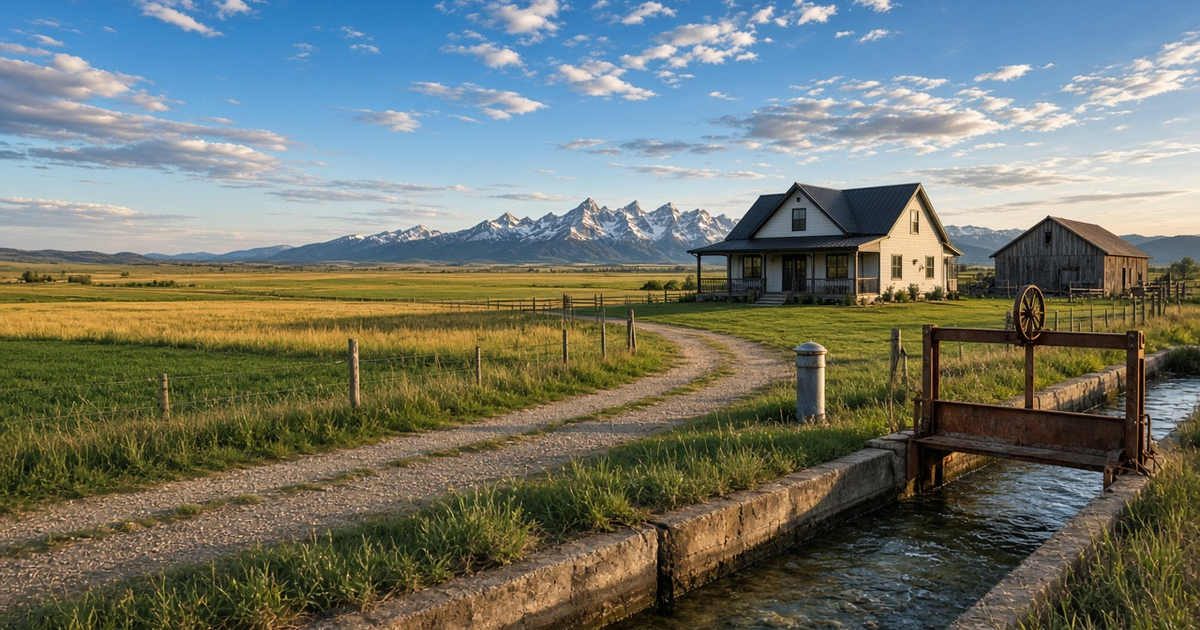
Short answer: When you buy acreage around Idaho Falls, the water, the well and the septic system each come with their own paperwork, and none of it is guaranteed just because the listing says "irrigated" or "well and septic." Ask for the water right numbers or irrigation share certificates, the well log from the Idaho Department of Water Resources (IDWR) and the septic permit records from the local public health district, and make your offer contingent on checking all three.
I'm Jacob Marcovitz, a REALTOR® with Keller Williams Realty East Idaho. A lot of my buyers want a few acres on the edges of Iona, Ucon, Rigby or Shelley for horses, a big garden, a shop or just space. I'm a Realtor, not a water rights attorney, engineer or septic designer, so this guide sticks to what Idaho law and the agencies themselves say, with links so you can check each point.
What kinds of irrigation water can come with Eastern Idaho acreage?
Irrigation water on a rural parcel usually comes in one of four forms, and each transfers differently. These descriptions come from IDWR's irrigation organizations page and the local districts' own FAQs.
Irrigation district
- What it is: a public, semi-municipal entity that holds the water rights, owns the canals and assesses landowners for upkeep, per IDWR
- How it transfers: with the land. Progressive Irrigation District's FAQ says the water "is attached to the land and may not be transferred," and that water rights pass "through the deed at closing."
- What you pay: an annual assessment. Progressive and New Sweden both bill in early November, due December 20 or in halves (December 20 and June 20).
- Local examples: Progressive Irrigation District (2585 N Ammon Rd), New Sweden Irrigation District (2350 W 17th St) and Idaho Irrigation District (496 E 14th St) all have Idaho Falls offices.
Canal or ditch company shares
- What it is: a private, non-profit company that holds the water rights. IDWR says members own shares, water "is normally allocated annually by share," and shareholders pay assessments.
- How it transfers: through the company, not automatically with the deed. Progressive's FAQ notes canal company shares can sometimes be moved to other land, so confirm the shares are being sold with the parcel.
- Local examples: IDWR's statewide list includes Rigby Canal & Irrigating Co and North Rigby Irrigation & Canal Co
A water right in the owner's name
- What it is: a right recorded with IDWR, such as one for an irrigation well, with its own water right number.
- How it transfers: the new owner must notify IDWR within 120 days (more on that below).
Domestic well only
- What it is: no irrigation right at all, just the household well under Idaho's domestic exemption, which covers watering up to one-half acre (details below).
- Why it matters: five acres with only a domestic well is not five irrigated acres.
How do I check a water right before I buy?
Ask the seller for the water right or adjudication claim numbers in writing. IDWR's own ownership change form says "the seller should be able to provide you with the water right or adjudication claim number(s)." Then look each one up in IDWR's Water Rights & Adjudication Search, which shows the record, related documents and a printable map. Check that the place of use covers your land.
After closing, Idaho Code § 42-248 requires the new owner to notify IDWR of the change in ownership within 120 days. The filing fee is $25 per right, or $100 per right if the right is being divided between owners. There's no fee for a claim still pending in an adjudication. Two things to know:
- Partial rights: if you're buying only part of the seller's land, IDWR says the right may need to be split, and the deed should spell out how the water is divided.
- District or company water: if your water comes from an irrigation district or canal company that holds the rights, IDWR's form says not to use it. Contact the district or company instead.
Can I get a new irrigation water right if the land doesn't have one?
Usually not. IDWR's amended Snake River Basin moratorium order (July 16, 2024) suspends action on new applications for permits to appropriate water from the Snake River upstream from Swan Falls Dam and the surface and ground water sources tied to it. The order lists its exceptions. It does not apply to domestic ground water use (including livestock watering), to permits to replace or deepen existing wells under valid rights, or to transfers of existing rights. The water already on the land is what you're buying.
Existing ground water rights aren't untouchable either. In the Surface Water Coalition delivery call on the Eastern Snake Plain Aquifer, IDWR's September 8, 2026 status update lists 930 ground water rights subject to its May 14, 2026 curtailment order, which covered rights junior to October 11, 1900. As of that update, curtailment proved unnecessary for 542 of them (for example, rights within the domestic exemption or covered by an approved mitigation plan), and 355 had been curtailed by the user. If there's an irrigation well, ask for its priority date and whether it's covered by a mitigation plan.
How much can I do with a domestic well?
Under Idaho Code § 42-111, a domestic use covers water for a home, livestock and related purposes, "including irrigation of up to one-half (1/2) acre of land, if the total use does not exceed thirteen thousand (13,000) gallons per day." A well used that way doesn't need an IDWR water right permit under § 42-227. IDWR notes the Legislature revised these statutes, with changes that took effect February 17, 2026.
- Half an acre is the cap: a lawn, garden and a small pasture can add up past half an acre fast. Anything beyond that needs irrigation water from a district, a company or a recorded right.
- New subdivisions are different: § 42-227 now requires an IDWR permit for new domestic uses beyond in-home use and livestock watering in subdivisions applied for on or after July 1, 2025 in moratorium or ground water management areas. Under § 42-111, a "subdivision" means five or more lots. In a newer rural subdivision, ask how outdoor watering is covered.
What should I check on the well?
Start with the paperwork. IDWR's Well Construction Search shows driller's reports (well logs) with depth, depth to water and flow rate, covering most reports from July 1987 on. Search by the well tag number (a "D" plus 7 digits on a metal plate on the casing) or by township, range and section from the deed.
- Permits: wells must be drilled by an IDWR-licensed driller, with a drilling permit before a well is built or changed. Under Idaho Code § 42-235, it's $75 for a domestic well and $200 for other wells.
- Water quality: private wells aren't regulated like public water systems. The Idaho Department of Environmental Quality says private wells should be tested for nitrate and bacteria at least once a year, and more often for nitrate if a pregnant woman or an infant will drink the water. The Idaho Department of Health and Welfare adds testing for metals and other contaminants every 3 to 5 years, and says about 30% of Idaho residents rely on private wells.
- Free state testing: IDHW lists a free well testing kit program starting fall 2026, but says it can take up to two months, too slow for most inspection periods. Use an Idaho-certified lab during your contract.
- Flow: the log shows what the driller recorded at construction, not today. Have a licensed professional run a flow test during your inspection period.
How do septic permits and inspections work here?
In Idaho, septic systems are permitted by the local public health district under the state's subsurface sewage disposal rules, IDAPA 58.01.03. Which district depends on the county:
Bonneville and Jefferson counties (Iona, Ucon, Rigby)
- Agency: Eastern Idaho Public Health (EIPH), which serves Bonneville, Clark, Custer, Fremont, Jefferson, Lemhi, Madison and Teton counties
- Records: EIPH's septic records request can return the permit, the inspection report (tank and drainfield size) and the as-built drawing. Records go back to 1971, you'll need the parcel number and legal location, and EIPH asks for three business days.
- Evaluating raw land: EIPH's permit packet lists a $450 speculative site evaluation "for potential purchase of property," which can be credited toward a permit within one year. An individual system permit is $900 and is valid for two years. EIPH says to plan on at least two weeks to process an application, and test holes may be required.
Bingham County (Shelley, Blackfoot)
- Agency: Southeastern Idaho Public Health (SIPH), Bingham County office at 145 W Idaho Street, Blackfoot, (208) 785-2160
- Evaluating raw land: SIPH lists a $300 speculative site evaluation, requires an onsite evaluation for every application, and says the owner must provide test holes 8 to 10 feet deep depending on the soil.
Under IDAPA 58.01.03, a drainfield must be at least 100 feet from any well and a septic tank at least 50 feet from a private well, so on raw land both have to fit. On an existing home, have the system inspected and pumped. DEQ's guidance is to pump and service every two to three years, so ask when it was last done.
What about the ditches, headgates and canal easements?
A ditch through the property comes with rules that surprise new owners. Idaho's ditch statutes (Title 42, Chapter 12, renumbered in 2026; see the current chapter) say:
- Piping or moving a ditch: allowed at your own expense, but only with the ditch owner's written permission first, and you carry any increased maintenance costs (now § 42-1203)
- Encroachments: no fences, gates, roads, structures, landscaping or trees in an irrigation entity's easement without its written permission (now § 42-1205). Unapproved ones can be removed at your expense.
- Maintenance room: Progressive and New Sweden both say they currently need 15 feet from the bank to maintain their canals.
- Jefferson County setbacks: the county zoning code sets building setbacks of 60 feet from a canal's high-water mark and 80 feet from an elevated canal.
Ask how water is ordered and delivered. Progressive's FAQ says water takes about 48 hours to arrive after you order, delivery can't start before April 1 and must end by October 31, and community ditches are normally maintained by the landowners who use them. In 2026, Progressive's board ended the season on October 15. Find the headgate and ask who shares the ditch and who maintains any pump.
Can I split the land or add another house?
That's a county question, and the answer changes across county lines:
Bonneville County A-1 Agricultural zone
- Dwelling lots: minimum lot size of one acre, with an average density of one lot per 10 acres within one mile of a city or urban growth area, one per 20 acres out to seven miles from a city of more than 500 people, and one per 60 acres beyond that (Bonneville County Code § 156.126)
- Further splits: the code says lots "cannot be further divided unless rights are specifically transferred to the new owner of said lot," so ask whether any building rights come with the parcel
Jefferson County agricultural zones
- Minimum lot sizes: 40 acres in AG-40, 20 in AG-20 and 10 in AG-10, with one single-family home per minimum lot size; R-5 and R-1 zones allow 5- and 1-acre lots (Jefferson County Code)
- Health standards: any lot created must be at least one acre and meet health district standards for a well and septic
Bingham County
- Where to ask: Bingham County Planning and Development. Call before you count on a split.
When land with available surface water is subdivided, Idaho Code § 31-3805 says the plat won't be approved unless the developer provides for irrigating the lots with it.
Will acreage get an agricultural property tax break?
Only if it's actually farmed. Under Idaho Code § 63-604, land of more than five contiguous acres (including the homesite) can be taxed as agricultural if it's actively used for crops, nursery stock or for-profit grazing. Five acres or less is presumed non-agricultural unless it's been farmed for the last three growing seasons and produced at least 15% of the owner's or lessee's gross income, or at least $1,000 in gross revenue the prior year. Land used to graze horses kept "primarily for personal use or pleasure" doesn't count. Separately, the homeowner's exemption covers your home and up to one acre; my property taxes and HOAs guide explains it. Ask the county assessor how the parcel is classified today.
What's on your acreage due-diligence checklist?
Here's the order I work through with buyers, starting on day one of the inspection period.
- Get the water documents in writing. Water right numbers, the irrigation district, or share certificates and how many shares are included. Put them in the contract.
- Look up every water right in IDWR's search. Confirm the owner, the use, the priority date and that the place of use covers this land.
- Ask for the last assessment bill and confirm nothing is past due. The City of Idaho Falls' New Sweden plat disclosure says unpaid assessments are a lien on the land and water can be withheld until paid.
- Find the delivery. Walk the headgate, ditch or pump, and ask who shares it.
- Pull the well log from IDWR.
- Test the well. At minimum bacteria and nitrate from a certified lab, plus a flow or yield test by a licensed professional.
- Request the septic records. EIPH or SIPH, depending on the county. Then have the system inspected and pumped.
- For raw land, order a speculative site evaluation before you're locked in, so you know a septic system can be permitted.
- Read the title report for easements (ditches, shared wells, access roads), and get a survey if boundaries are unclear.
- Call county planning and zoning to confirm the zone, that it's a legal building lot, and any split rules.
- File the IDWR ownership change within 120 days of closing if a water right is in the owner's name, and notify the district or canal company.
If the water is a big part of what you're paying for, have a water rights attorney review the records before your contingencies expire.
Where around Idaho Falls do buyers find acreage?
Most of my acreage searches land on the rural edges of Iona, Ucon, Rigby and Shelley. My Rigby, Iona, Ucon or Shelley guide compares the towns, and my INL commute guide covers the drive. Some new construction has well and septic too, like Copper Creek's Saddle Hill in Rigby (see my Copper Creek guide). Planning to buy land and build? Read my production vs. custom builder guide.
More guides for buying around Idaho Falls
- Utilities: setting up power, gas, water and trash
- Taxes and costs: property taxes and HOAs explained and Idaho Falls cost of living
- Moving here: how to buy a home in Idaho Falls as an out-of-state relocator and the new-to-Idaho checklist
- About me: Meet Jacob Marcovitz, Realtor at Keller Williams East Idaho
Details come from IDWR, the Idaho Code, IDAPA 58.01.03, EIPH, SIPH, Idaho DEQ, IDHW, Progressive and New Sweden irrigation districts, and the Bonneville and Jefferson county codes, all checked October 29, 2026. Fees and rules change, so confirm with the agency. I'm a Realtor, not an attorney or water rights expert, and nothing here is legal advice. For a specific parcel, talk to a water rights attorney.
Jacob Marcovitz, REALTOR®, Keller Williams Realty East Idaho, 3525 Merlin Dr, Idaho Falls, ID 83404. Looking for acreage around Idaho Falls? Call or text 208-821-6217, or connect with me here, and I'll help you check the water, well and septic before you commit.

Jacob Marcovitz
| Jacob Marcovitz | Keller Williams Realty East Idaho
or another way