
Categories
Living In Eastern IdahoPublished October 6, 2026
What Winter Is Really Like in Idaho Falls

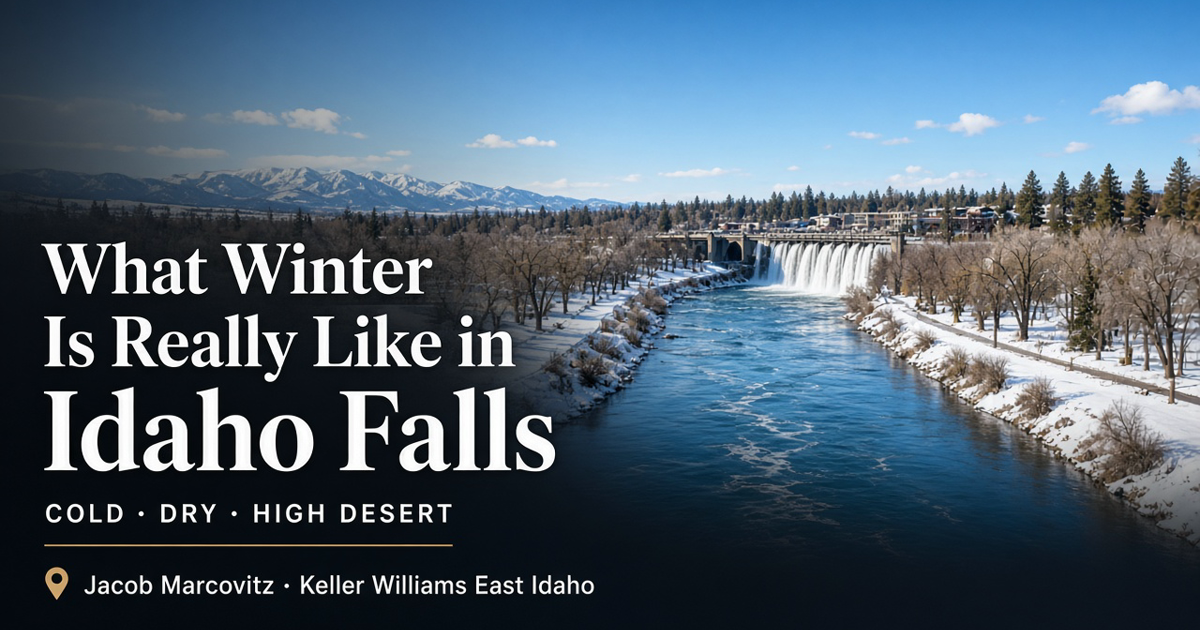
Winter in Idaho Falls, Idaho, is cold, dry, and high-elevation — not a Great Lakes lake-effect snowbelt and not a Seattle drizzle winter. At Idaho Falls Fanning Field (NOAA station USW00024145), the 1991–2020 climate normals put January at about a 28.7°F average high and 12.1°F average low, with roughly 10.07 inches of liquid-equivalent precipitation for the whole year. Snow falls, streets get plowed on a priority system, schools usually stay open unless conditions turn extreme, and weekend ski options include Kelly Canyon nearby and Grand Targhee farther out toward Teton Valley.
I’m Jacob Marcovitz, a REALTOR® with Keller Williams Realty East Idaho. I help INL relocators and out-of-state buyers set honest expectations before their first Eastern Idaho winter. Call or text 208-821-6217 or start at eastidahojacob.com. Pair this with my Idaho National Laboratory Relocation Guide and the INL Commute Guide: Highway 20, Park-and-Rides & the Motor Coach. Neighborhood feel is covered in Idaho Falls vs Ammon for INL relocators & families, schools in Eastern Idaho School Districts Explained, budgets in Idaho Falls & Eastern Idaho Cost of Living, and the buying process in How to Buy a Home in Idaho Falls as an Out-of-State Relocator.
How cold does winter get in Idaho Falls?
January is the coldest month in the official Fanning Field normals. Using NOAA NCEI 1991–2020 monthly normals for Idaho Falls Fanning Field (USW00024145):
December
- Avg high: 30.3°F
- Avg low: 13.4°F
- Avg mean: 21.9°F
January
- Avg high: 28.7°F
- Avg low: 12.1°F
- Avg mean: 20.4°F
February
- Avg high: 34.2°F
- Avg low: 15.7°F
- Avg mean: 24.9°F
The same station’s annual normal averages about 44.2°F (annual high 57.5°F / low 30.9°F). That is a high-desert / Snake River Plain pattern: cold nights, bright days, and big swings between noon and midnight.
Relocators should plan for subzero mornings some winters even when the monthly average low sits in the low teens. Averages are not the coldest night of the year. Check the current National Weather Service forecast for Idaho Falls before you judge a winter from one cold snap.
Elevation context (official): the NWS point forecast for Idaho Falls lists about 4,701 ft; Idaho Falls Regional Airport (KIDA / Fanning Field area) is roughly 4,744 ft per FAA airport data. Thin air and dry cold feel different than the same thermometer reading at sea level.
How much snow does Idaho Falls really get?
There is no single official “town snowfall” number I will invent for you. In the 1991–2020 U.S. Climate Normals, Idaho Falls Fanning Field (USW00024145) publishes strong temperature and precipitation normals — but the snowfall normal fields for that airport station are blank / missing in the NCEI extract checked on 2026-09-09. Aggregator websites that print one annual total for “Idaho Falls” often blend different nearby stations, and those numbers disagree wildly.
What is publishable from NOAA for a nearby cooperative station: Idaho Falls 16 SE (USC00104456) — a higher-elevation site southeast of the city (station elevation about 1,776 m / ~5,828 ft in the NCEI record) — shows a 1991–2020 annual snowfall normal of 65.7 inches, with January and December the snowiest months at that station (17.0" and 16.0" monthly normals). That foothills / SE station is not the same as living on the valley floor near downtown or Ammon.
Practical takeaway for buyers: expect real snow events, intermittent ice, and dry cold — but treat any single “Idaho Falls gets X inches a year” claim with skepticism unless it names the NOAA station and the normals period. Prefer the NOAA Climate Normals Quick Access tool and the National Weather Service for event-by-event totals.
Annual liquid precipitation at Fanning Field is only about 10.07 inches (1991–2020). That dry annual total is why winters here feel crisp and sunny between storms, not endlessly gray.
Online takes swing between “it’s not that bad” and “−20°F every day.” The NOAA normals sit in the middle: cold January averages near the upper 20s / low teens at the airport station, a dry ~10-inch annual precip climate, and real snow events — not endless lake-effect cover. Relocators usually underestimate routines (plow parking, kid layers, tires) more than the thermometer.
What is winter driving and city snow removal like?
Idaho Falls plows on a priority system, and parking rules matter after a qualifying snow.
Per City of Idaho Falls snow materials and Title 9, Chapter 5 parking restrictions:
- A snow event is defined when more than two inches (2") of snow accumulates on city roadways (as determined/posted by the City).
- During a snow event, vehicles need to be off restricted streets so plows can work; illegally parked cars can be ticketed or relocated.
- Seasonal snow-parking restrictions commonly run roughly November 15 through March 15 (confirm the current year’s CivicAlert / city notice).
- Arterial and collector streets are signed / treated differently from residential zones; the City publishes snow-zone maps and plow-related GIS layers.
- Sidewalk snow next to private property is generally the adjacent property owner’s responsibility under city code (Title 8 sidewalk provisions referenced in the City’s snow manual).
Relocator habits that matter: good all-season or winter tires, a scraper that lives in the car, and a plan for overnight street parking on plow nights. Ammon and other nearby cities have their own street departments — do not assume Idaho Falls rules apply one block outside city limits.
I will not invent Highway 20 travel times for storm mornings. Check ITD road reports and the National Weather Service before you commit to a desert Site drive.
Do D91 and D93 close school for snow and cold?
Usually schools try to stay open. Closures happen for extreme cold, impassable roads, or other safety issues — not for every light dusting.
Bonneville Joint School District 93 (covers much of Ammon / Iona / Ucon and parts of the Idaho Falls area) states on its Weather Closures page that it generally does not consider closing unless temperatures drop below −20°F, or blizzard / drifting snow makes roads impassable. On rough mornings, staff assess roads early; the district describes a decision window around 5:30 a.m. on whether to close or delay two hours, with parent messages targeted around 6:00 a.m.
Idaho Falls School District 91 publishes School Closure Guidelines. The superintendent aims to decide by 6:30 a.m. using early-morning temperatures, forecasted highs, wind chill, and road conditions. Parents retain the final call — if you keep a child home for safety, D91 describes that as a verified absence with a parental note. Confirm your address’s district before you buy; city limits ≠ school boundaries (see also Idaho Falls vs Ammon).
How do homes heat, and what should you pack?
Eastern Idaho winters are a heating story, not a cooling story. At Fanning Field, NOAA’s 1991–2020 annual heating degree day normal is about 7,792 HDD (base 65°F), versus only about 249 cooling degree days. That lines up with what buyers feel on utility tours: furnaces run hard from late fall through early spring.
Pack for dry cold, not coastal damp cold:
- Insulated waterproof boots, not fashion sneakers
- Real gloves, a warm hat, and a windproof outer layer
- Layers you can peel at noon when the sun is out
- A garage-door opener that works when your phone is frozen in the cupholder
Ask sellers or builders about furnace age, insulation, and whether the home has a covered parking option. Newer construction on the Ammon side, such as Granite Creek and Hawks Landing, often markets modern insulation and efficient furnaces; still verify with an inspection and utility history rather than brochure claims. My Eastern Idaho new-construction map covers those communities.
Where can you ski from the Idaho Falls area?
Winter here is also a recreation season if you want it.
- Kelly Canyon Resort (near Ririe / Caribou-Targhee National Forest) is a local hill. Kelly Canyon Ski Patrol materials describe it as about 26 miles northeast of Idaho Falls. I am not inventing storm-day drive times — check roads the morning you go.
- Grand Targhee Resort (Teton Valley / Alta, Wyoming side of the range) lists about 83 miles from Idaho Falls on its official trip-planning page, which also recommends checking road reports before you drive. Jackson Hole is a separate, farther day-trip decision for many families.
Ski snowfall inch marketing from resorts changes by season — check each mountain’s current report rather than a blog average.
What should INL Site employees know about winter commuting?
If you report to the Idaho National Laboratory desert Site (west on U.S. Highway 20) rather than only the in-town Research and Education Campus, winter is an operations issue: visibility, ice, wind, and whether you drive yourself or board an INL motor coach from a park-and-ride.
I am not publishing invented Site drive times here. Use my INL Commute Guide for boarding-point context, get your reporting location in writing, and treat storm mornings as “leave earlier or take the coach” mornings — not average-day GPS estimates.
Many relocating families prefer temporary housing for the first winter weeks so they can learn school delay texts, plow parking rules, and Site boarding before they lock a neighborhood.
Talk through your move timeline
Quick relocator checks: winter driving habits usually matter from late fall into early spring (city snow-parking season materials commonly reference mid-November through mid-March). You do not need a 4×4 — good tires and judgment matter more — but match the vehicle to a Highway 20 Site commute if that is your job. If your timeline allows, a short lease through a few storms is excellent due diligence; if you must buy first, prioritize garage parking, school-district texts, and a realistic commute plan.
If you are relocating to the Idaho Falls / Ammon area for INL or another Eastern Idaho job, I can help you shortlist neighborhoods with winter logistics in mind — schools, parking, and commute — without the scare stories. Call or text 208-821-6217 · eastidahojacob.com. More about working with me: Meet Jacob Marcovitz.

Jacob Marcovitz
| Jacob Marcovitz | Keller Williams Realty East Idaho
or another way